
While the exact origin of the Natale name is unknown, one of the earliest known records of its use comes from the province of Treviso, in the Veneto region in northern Italy. Records show the “Nadale” family moved from Oderzo into the city of Venice in the year 1297 AD.
Oderzo is traversed by the Monticano River, a tributary of the larger waterway known as the Livenza River. The “centro storico”, or town center is rich with archeological ruins which give insight into Oderzo’s history as a notable crossroad in the Roman Empire.
Spelling discrepancies exist due to regional variations. Example: Natale, Natali, Nadale, Di Natal and so on due to dialectal differences or transcription errors in old records. Early references are synonymous with the day of a martyr’s or saint’s death, and the name takes on the meaning of “birth to eternal life”. It was later used in honor of the Christmas festival and in celebration of Jesus Christ. Buon Natale!
CHURCH RECORDS:
Following the Council of Trent (1564 AD), Catholic parishes meticulously recorded baptisms, marriages and burials. Since Natale is tied to Christian traditions, parish records are a rich source, especially in areas like Naples or Palermo where the surname is common. These records, often in Latin or Italian, list Natale as a surname or even a given name used in baptismal records.
ETYMOLOGY:
The surname Natale derives from the Latin word natalis, meaning “of or pertaining to birth”. Natale means Christmas in Italian and “Babbo Natale” is the Italian name for Father Christmas (Santa Claus). As a result, it was frequently given as a name to children born around Christmas time.
Natale is a patronymic surname. Patronymic names come from the male lineage in a family. They often signify that someone is a specific person’s son. Think of it like an identification shortcut. For example, Pietro Di Natale would translate to Peter, the son of Natale.
GEOGRAPHIC DISTRIBUTION:
The Natale name is commonly found throughout Italy. Over time, due to migration, the name has spread worldwide, especially to the United States, Argentina, and other countries with large Italian diaspora communities.
HISTORICAL CONTEXT:
Religious Significance – In medieval Italy, names with religious connotations were popular, reflecting the deep Catholic faith of the society. Natale was associated with Christmas and could have been given as a nickname to someone born during the Christmas season or to families devoted to this holiday.
Medieval Naming Traditions – Surnames in Italy began to develop between the 10th and 14th centuries, often reflecting occupations, geographic origins, or personal traits. The surname Natale likely evolved as families sought to distinguish themselves, particularly in areas where shared first names were common.
Migration and Variations – During the Italian unification (19th century) and subsequent waves of emigration (late 19th to early 20th centuries), individuals with the Natale surname moved to North and South America. This lead to the pronunciation, such as Natali or Di Natale (a common variation meaning “of Natale).
HERALDRY:
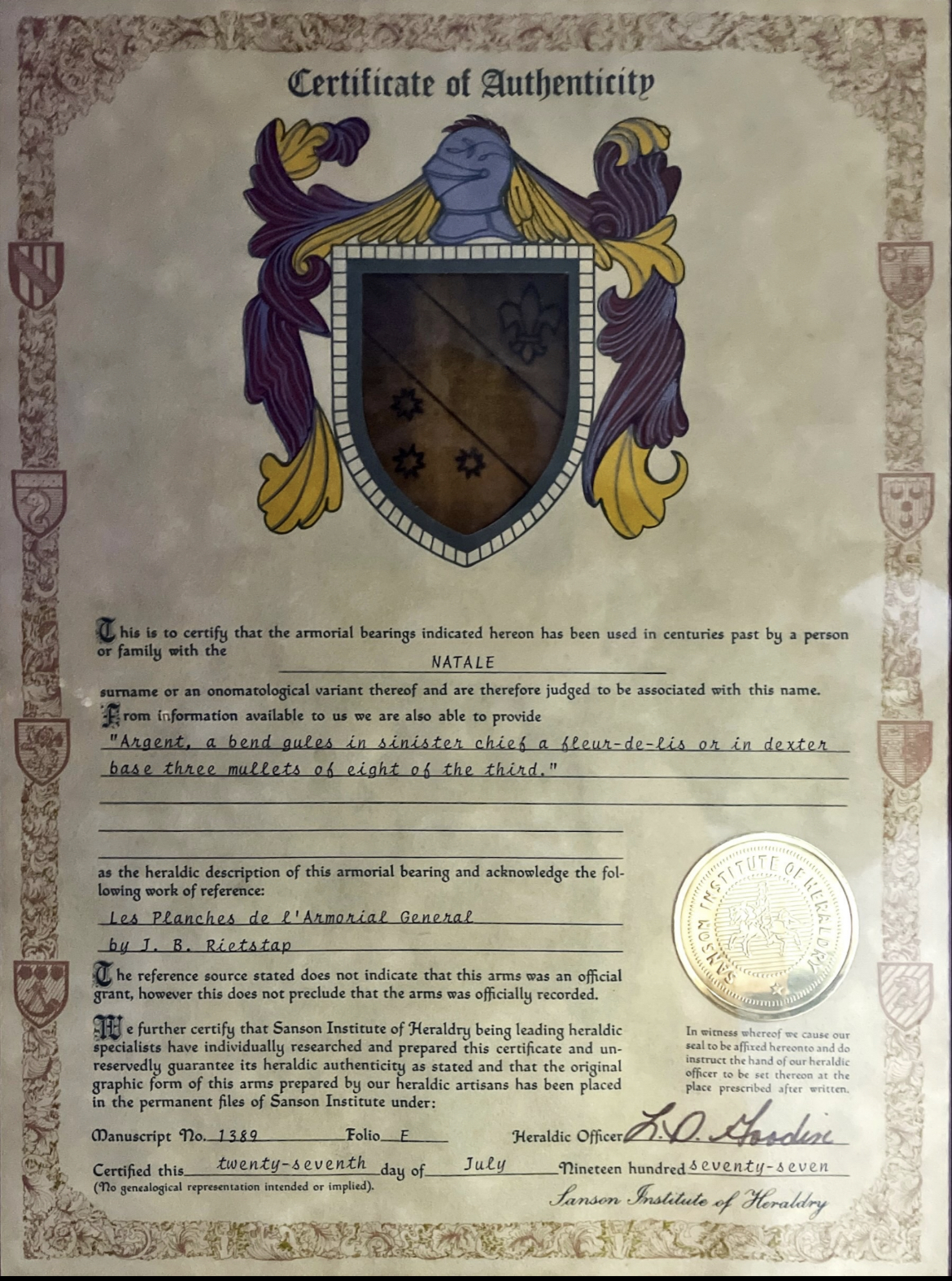
Some families bearing the Natale surname developed coasts of arms, typically featuring symbols of religious or seasonal significance, such as stars (representing Christmas), crowns, or other decorative elements linked to Italian nobility or regional identities.
PROMINENT FIGURES:
Over time, individuals with the surname Natale have become notable in various fields, some of them include:
Andrea Natale – An Italian born American Cardiologist and Electrophysiologist known for his work on heart rhythm diseases.
Ralph Natale – An American mobster who was the boss of the Philadelphia crime family.
Anthony Natale – A deaf Canadian born American Actor.
Greg Natale – An Australian interior designer.
Lou Natale – An award winning Canadian composer.
Patrick Natale – An American politician.
Antonio Di Natale – An Italian professional footballer (soccer).
Sonia Natale – An Argentine mathematician.
Stefano Di Natale – An Italian long distance runner.
The following ancestry timeline is based off of the personal DNA results of Sandro Natale, born to Mother Linda and Father Alessandro Natale in Southern California in 1980. The data shows partial lineage of the Natale name dating back as far as the 18th century in the Iberian peninsula, modern day Spain and Portugal.
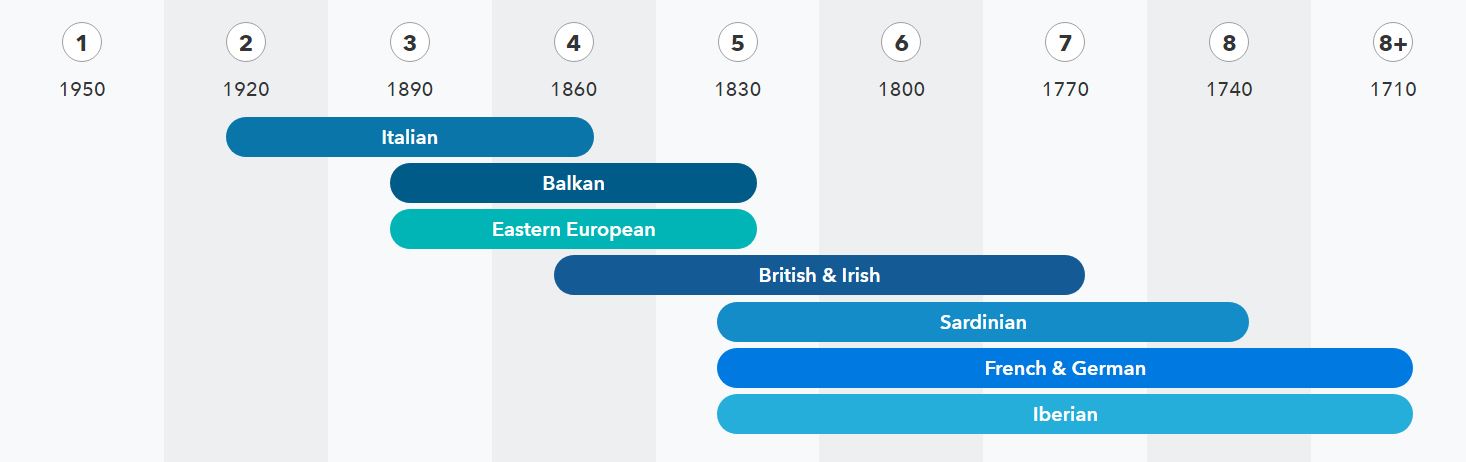
This Ancestry Composition result helps to estimate the generation range where the Natale surname is likely to have had a single relative who descended from a single population.
These results may be helpful for learning about the Natale genealogy, in figuring out from which ancestors a particular ancestry may have been inherited, or for piecing together the history of the Natale’s likely migrations.
I’ve done my best to summarize available knowledge about the Natale lineage. If you’ve found this page while looking for more information regarding our family, and have some additional information to help build out the family tree, I encourage you to reach out to me to share your thoughts and ideas in the comment box below. Grazie Mille!
 Welcome - Benvenuti